Saturday, February 12, 2011

Khasab

When the road was built along the coast to replace the steep and windy one over the mountains somebody decided that it would be nice to make a new beach. So they made this one which has become so popular that on fridays you need to grab your spot early or miss out.


Dhows like these are now made from fibreglass.


This marina was reclaimed from the bay when the new wharf was being constructed. In the background is Khasab castle.


Ali now has a dhow which is used to take scuba diving parties to remote bays in the Musandam area for camping and diving weekends. While it is basic it is spacious and carries quite a lot of divers. A carpet and cushions are laid out on the deck in the traditional Omani fashion.


Around Khasab

Ali drove us around Khasab to show us the sights and the more unusual things which the Omani people just take for granted.
Originally, the people of this area came from Persia where the houses were traditionally built in the drystone method. The Arabic/African way was to build in mud. There are several ruins around the area which show the stone construction.


Ali took us to a village outside Khasab which was located at the end of a narrow wadi. The picture below shows a goat house built into the space under a fallen boulder.


The boulders in this area were dislodged from the hill above where they were part of a cave system. The stone pictures, which we were told are ectographs, were carved approximately 3600 years ago. There were plenty to see and it made us wonder how many more were hidden underneath the boulders.


The Omanis are very easy going people and that is demonstrated quite well in this picture. The small boats you see are high speed smuggler's boats and the piles of goods on the wharf are the waterproof packages that they smuggle. This wharf is inside the protected customs area and is not a problem for the Omanis. The smugglers are Iranian who leave after dark to run to Iran, approximately 35km across the Straits of Hormuz. The Iranian coast guard shoot to kill if they discover them but the profit to be made means that there are plenty of smugglers. We were told about the smugglers when I asked why some of the boats were jet black with enormous twin outboard motors.
As it turned out, the smugglers go in daylight on fridays because it is the holy day and the coast guard are not there. In Oman they just shrug their shoulders and say "They are only smugglers".


Friday, February 4, 2011

Sur and Wahiba Sands

Yesterday we drove south to see the fishing and boat building town of Sur and on to Ras al Jinz to see the turtle sanctuary. From there we planned to continue on to see the Wahiba sands, a completely sandy desert. We left at 7.30am and arrived back at the hotel at 5pm after travelling 675km. It was a very long day, particularly when the last part of the drive was on single lane road, stuck behind trucks at 60-70kph. At times we were travelling at 130-140kph so we did get along at good speed where we could.


This picture shows the sand dunes in the distance.
The following posts have pictures of the things we saw.

Unfortunately we missed the turtle sanctuary so that will have to wait for another day. The Wahiba sands are really only accessible by 4wd so the corolla was not put to the test. We drove along the edge of the dunes without entering but in places there was sand blowing across the road as the wind got up. Reminded me of the beaches in WA after lunch when the Freo Dr. comes in.

There were donkeys, camels, goats and sheep roaming the sides of the road and sometimes we had to stop while they crossed. Along the coast we saw dolphins, turtles and people fishing so all in all it was a very varied day.


As you can see, there are some obstacles to avoid.


This was the coast road before cyclone Gonu hit the country in 2007.

A new four lane highway was built further up the hill and this road was left with a gap of about 200m. As a result we couldn't figure out how to access Wadi Tiwi which was signposted to be on this road. We did see it from the highway and we will try to get back there if we have time.

Thursday, February 3, 2011

These fishermen didn't catch anything while we were watching. Reminded me of my own efforts at home.

We stumbled across these flamingos as we started the the drive into the Wahiba Sands area. I don't know what the big birds behind the flamingos are but they were quite large. You can see the beginning of the sand hills in the back ground.


Did I mention that we saw a lot of camels on the trip?
Not all of them had chauffer driven transport.


This is a bus stop. There are all types along the road and all are built in the arabic architectural style.
This is Sandra's new best friend. We stopped at a servo to get reassurance
that we were on the right road and her Dad jumped out of his car to help. He
came over and introduced himself then, in very good english, gave us directions.
Once he had done that he brought his daughter over because she wanted to meet
the white
lady and have her picture taken. The clothes she is wearing are typical of the
women's clothing along the coastal area. Black is mainly worn in the city and in
the desert.


We saw a few sights along the way and stopped to watch turtles in the small bays, dolphins, goats and donkeys crossing the road and nautical roundabout ornaments


Roundabout the roundabouts

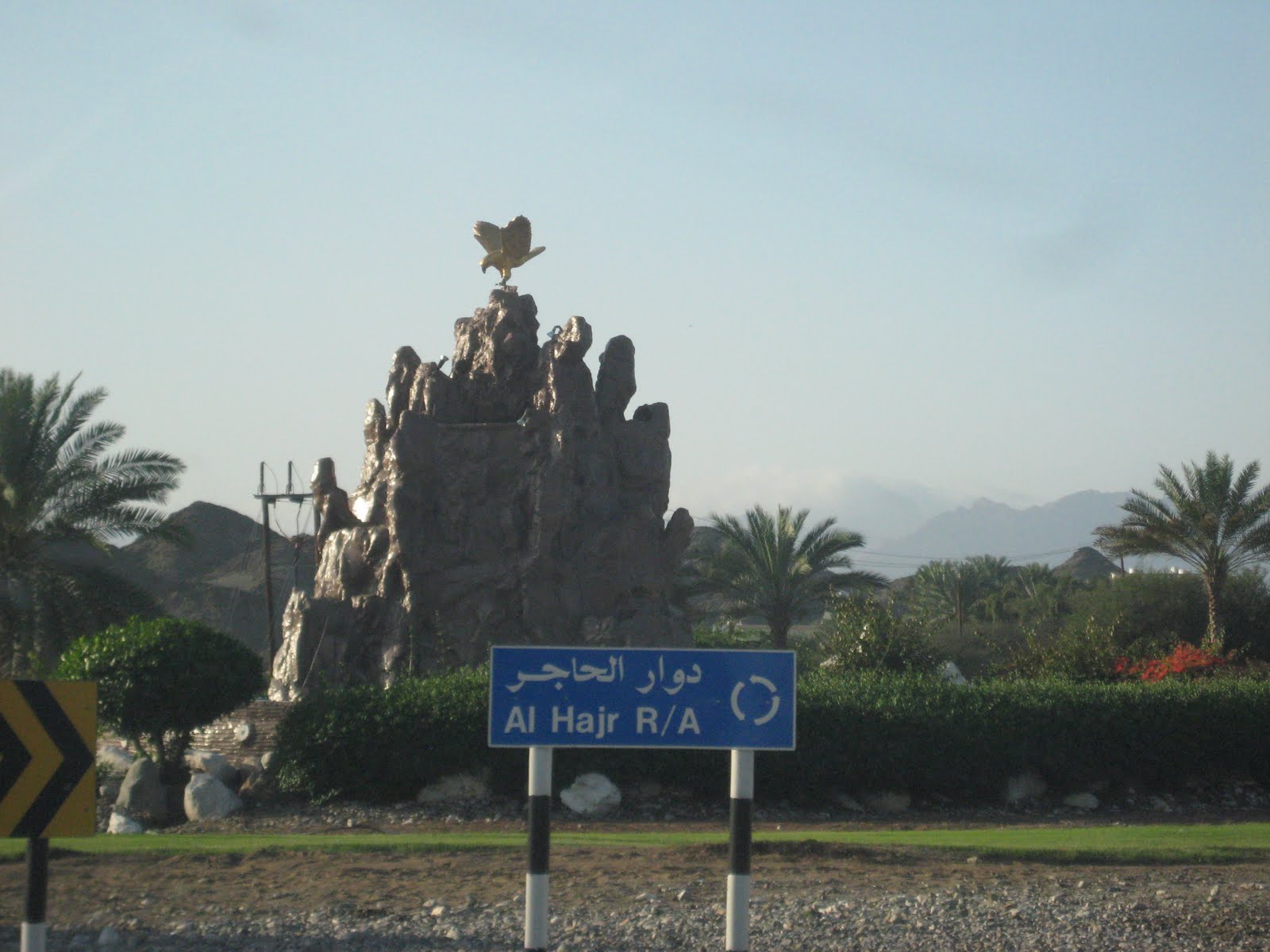
Along the way we passed some interesting roundabout ornaments. When someone over here gives directions it is often with reference to roundabouts. You can see why here.

Sur

We stopped off at Sur to have a look at the boat building yards where traditional dhows are built. We were told that they only used traditional methods of timber and wooden nails. All we saw was tech screws and power tools although there was some chiselling going on underneath one of the dhows. There was a completed dhow and two under construction. They were also building long rowing boats being built too.


The last piece of timber in the keel of this dhow has been made from an odd shaped piece of wood and blended into the shape of the keel.


This is the pile of timber that is used to construct the dhows. As you can see there are some odd shapes.